In the 1830s and 40s, the United States and Mexico were in a state of contention. Mexico would go on to lose a war against the temporarily independent Republic of Texas and then the United States soon after. They would lose much as a result, but what would things look like if they didn’t?
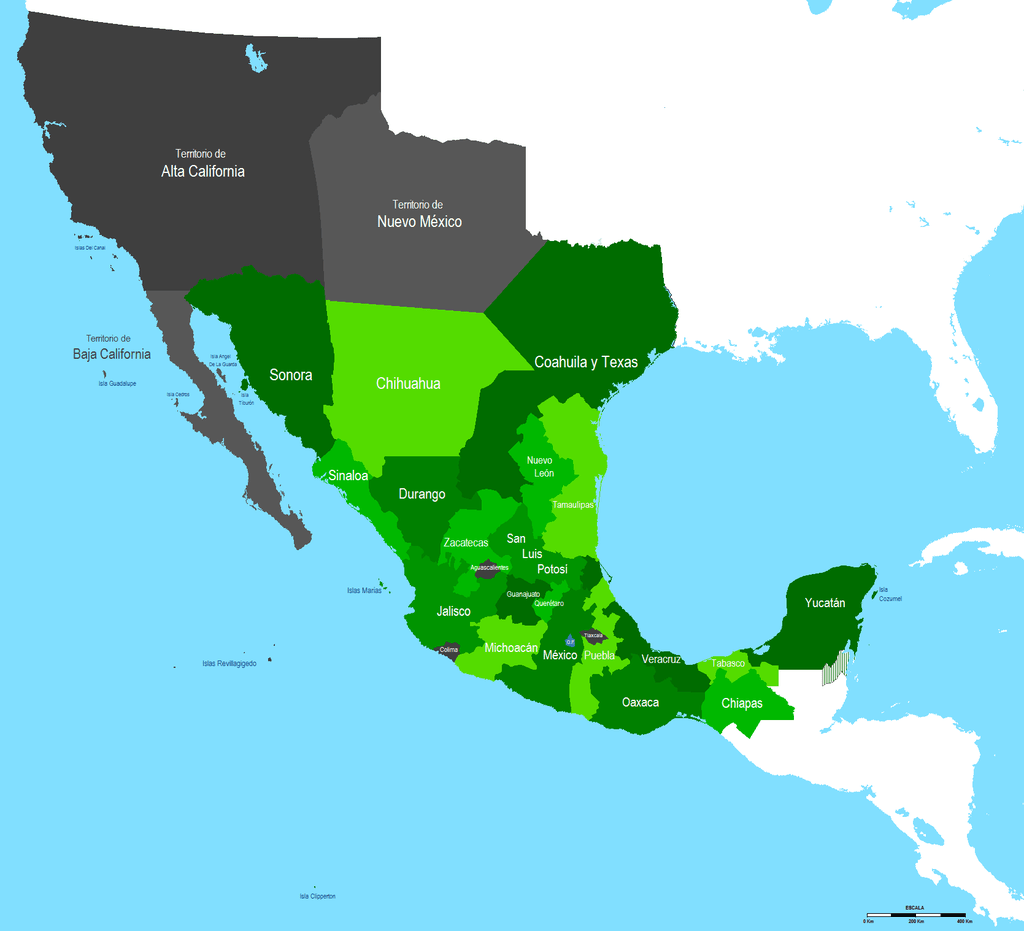
When Mexico declared its independence from Spain in 1810 and won it in 1820, the nation inherited a considerable chunk of land out west. The modern states of California, Arizona, New Mexico, Nevada, and Texas, along with parts of Wyoming, Colorado, Kansas and Oklahoma were part of Mexico’s territory. Mexico, over the course of this time, went from an empire, to a provisional government, to a federal republic, to a centralist republic, and finally a second federal republic, all between the years of 1820 and 1848.
Funnily enough, there was a Mexican leader named Antonio López de Santa Anna who became involved in both the Texas Revolution and the Mexican-American War, losing his presidency, the wars, and his leg twice (albeit the first and real leg was a different war). It was primarily a result of his failures as a general, politician, and diplomat that Mexico lost as much territory as it did, even after the conflicts. Blame must be shared with those who centralized the government however, causing the Mexican states to rebel in the first place.
If Mexico had not lost its territory in the north it would be around twice its current size today. The vast natural beauty and resources of those places would have been invaluable: Texas with its oil deposits, Arizona with the Grand Canyon, Utah with its salt flats, New Mexico with its copper, Nevada with its silver and eventual nuclear testing grounds/experimental facilities, Colorado with its mountain`s, California with its gold, fertile valleys and mediterranian climate, not to mention the countless waterways and natural harbors. Should all of these things have remained under the control of Mexico, it very well could have grown as a nation to rival and maybe even surpass the United States.
 World Civ 1 SLy
Leave a comment